 UCAS Oxbridge & medicine
 DAAD EPOS
 Fulbright Scholar
 Stipendium Hungaricum
 Sweden autumn 2027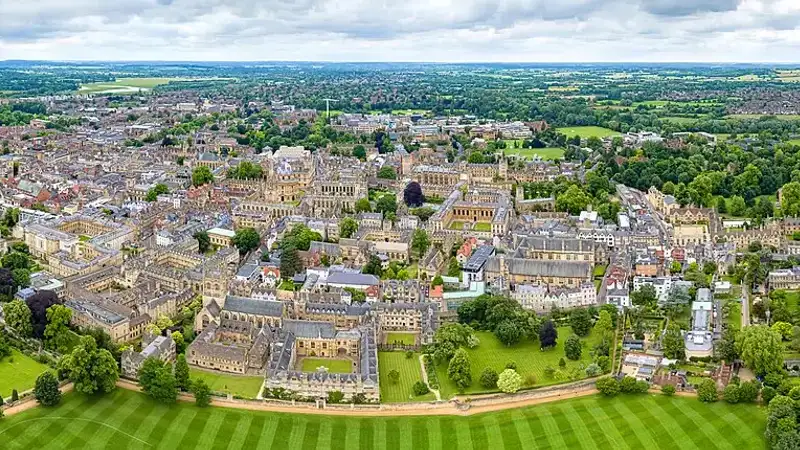
Rhodes Scholarship For Pakistan: The Complete Guide (Eligibility, Statements, References, Interviews)
Two Pakistanis a year win a fully funded place at Oxford through the Rhodes Scholarship. Who is eligible, the strict age rules, what the selectors look for, how to write the personal statement, choose referees and prepare for the interviews.
 Reading time19 min
 Sections30
 Updated9 October 2026
 Sources4 official
Photo: Chensiyuan, CC BY-SA 4.0, via Wikimedia Commons
The 60-second version
Key takeaways · then go as deep as you like- 1The Rhodes Scholarship funds postgraduate study at the University of Oxford in full, and is the oldest international graduate scholarship in the world.
- 2Pakistan has its own constituency with two scholarships available each year.
- 3Eligibility is strict: Pakistani citizenship, education in Pakistan, and age (18–23 on 1 October of the application year, or under 27 if you finished your first degree recently).
- 4For 2027 entry, the Pakistan application opened on 1 June 2026 and closed at 23:59 PKT on 5 August 2026.
- 5Selection looks at the whole person: academic excellence, energy, character, commitment to others and leadership.
- 6The application rests on a personal statement, an academic statement, a CV and several references; finalists face interviews.
2
Pakistan scholarships a year
18–23
Main age window
5 Aug
2026 closing date (PKT)
Oxford
Fees + stipend covered

Part 1 of 6
The basics
01Rhodes In One Minute
The Rhodes Scholarship, established in 1902, brings exceptional young people from around the world to the University of Oxford for postgraduate study. It is often described as the oldest and one of the most prestigious international scholarships.
Rhodes Scholars study for a master’s or doctorate at Oxford, usually for two or three years. The scholarship covers Oxford University and college fees, a living stipend, and travel to and from Oxford, and scholars join Rhodes House, a community of scholars from more than 60 countries.
For Pakistan, the important facts are simple: there is a dedicated Pakistan constituency, two scholarships are available each year, and eligibility is narrow by design. Rhodes is looking for exceptional young people early in their careers.
The short version
Rhodes = fully funded postgraduate study at Oxford
- two places a year for Pakistan
- for young Pakistani citizens educated in Pakistan
- selected on scholarship, character, energy and leadership.
02How Competitive Is It?
With two scholarships a year for Pakistan, Rhodes is among the most selective awards a Pakistani student can apply for. The Rhodes Trust does not publish the number of Pakistani applicants, but globally the Rhodes Scholarship receives many thousands of applications for around 100 places.
The pool is narrow, though, because of the age and education rules: you are competing with Pakistani graduates in a specific age window, not with everyone. Candidates who meet the rules and have an exceptional record should apply; there is no fee and the process itself is a valuable experience.
2
Pakistan places a year
~100
Rhodes Scholars worldwide a year
60+
Countries in the Rhodes community
1902
Year founded
03What The Scholarship Covers
- All Oxford University and college fees.
- A living stipend paid throughout the scholarship.
- Economy-class travel to Oxford at the start and back home at the end.
- Visa application costs and the Immigration Health Surcharge.
- Access to Rhodes House programmes, events and the global Rhodes network.
The scholarship is normally held for two years, with possible extension to a third year for a doctorate, subject to the Trust’s conditions. Read the current Conditions of Tenure for the exact terms.

Part 2 of 6
Are you eligible?
04Pakistan Eligibility, Exactly
Rhodes House’s eligibility checker for Pakistan sets out the rules. For 2027 entry they were:
- 1Citizenship: you must be a citizen of Pakistan holding a Pakistani passport.
- 2Education and residency: you must have studied at an educational institution in Pakistan for at least 4 of the last 10 years, and either completed a school or college leaving exam (Intermediate, A-level or equivalent) in Pakistan, or received (or will receive) an undergraduate degree from a university in Pakistan.
- 3Age: you must be aged 18–23 on 1 October 2026 (born after 1 October 2002 and before 2 October 2008), OR be under 27 on 1 October 2026 and have completed your first undergraduate degree on or after 1 October 2025.
- 4Academic level: you must have completed, or be about to complete, an undergraduate degree by the time you would start at Oxford, with a strong academic record.

Watch out: The age rule is absolute. If you are outside the window, you cannot apply for the Pakistan constituency, however strong your profile. Check your date of birth against the current year’s rules before doing anything else.
If you have strong connections to more than one Rhodes constituency but do not meet the citizenship or education rules for one, Rhodes House describes an inter-jurisdictional route. Read that page carefully; it is narrow.
05What Selectors Look For
The Rhodes selection criteria come from Cecil Rhodes’s will and have been modernised over time, but the core qualities are stable:
Academic excellence
Outstanding grades and intellectual ability; a serious reason for your Oxford course.
Energy to use one’s talents to the full
Evidence that you pursue things with energy: sport, arts, activism, enterprise or other demanding commitments.
Character and commitment to others
Truth, courage, devotion to duty, care for and protection of others, fellowship.
Leadership
Moral force of character, instincts to lead, and genuine interest in other people.
Rhodes is explicitly a “whole person” scholarship. Brilliant grades without a record of contributing to others, or a long list of activities without depth, rarely succeed.

Part 3 of 6
Building your profile
06The Typical Successful Pakistani Candidate
Pakistani Rhodes Scholars come from a range of universities and backgrounds. From those we know and the candidates we see, finalists tend to share:
Typical finalist (TeamOnline observation)
- Academics
- Top of their class at a strong Pakistani university
- Age
- Final-year student or recent graduate
- Service
- Sustained commitment to a cause or community
- Leadership
- Founded or led something with real impact
- Energy
- Serious pursuit outside academics: sport, debate, arts, research
- Course
- A precise reason for a specific Oxford course
- References
- Referees who know them deeply and write with examples
- Voice
- A personal statement that sounds like a real person
An observation, not an official profile.
07Planning Rhodes From Your First Year
Because the age window is narrow, many Pakistani candidates apply in their final undergraduate year or within a year or two of graduating. That means the profile is built during university. A realistic plan:
- 1
First year
Academic foundation
Aim for the top of your cohort; find subjects you love.
- 2
Second year
One serious commitment
Choose one cause, organisation or pursuit and commit for the long term.
- 3
Third year
Lead
Take responsibility: lead a society, start an initiative, run a project with real outcomes.
- 4
Final year
Deepen and reflect
A strong thesis; keep leading; start drafting statements in spring.
- 5
Application summer
Apply
June–August, with referees briefed early.

Counsellor’s tip: Rhodes selectors notice depth. One initiative you built over three years says more than ten society memberships.
08Activities That Show “Energy To Use Your Talents”
The Rhodes criterion about energy is often misunderstood as “do lots of things”. It means pursuing something demanding wholeheartedly. Pakistani finalists have shown it through:
- Competitive sport at university, provincial or national level.
- Debating, Model UN or moot court at a high level.
- Serious arts practice: music, theatre, writing, filmmaking.
- Founding and running a social enterprise or community programme.
- Sustained research alongside studies, with outputs.
What matters is that you can talk about it with real depth: what it demanded, what you learned and why it matters to you.
09Oxford Courses Pakistani Applicants Often Choose
| Field | Examples of Oxford courses | Suits applicants who… |
|---|---|---|
| Policy and government | Master of Public Policy, MPhil Politics | Want to work on governance and public institutions |
| Development | MSc/MPhil Development Studies, MSc Economics for Development | Have studied economics or social sciences and care about development |
| Economics | MPhil Economics, DPhil Economics | Have strong quantitative foundations |
| Law | BCL, MSc Law and Finance | Have an outstanding law degree |
| Health | MSc Global Health Science, MSc International Health and Tropical Medicine | Have medical or health backgrounds |
| Sciences and engineering | DPhil programmes in sciences, engineering and computing | Have research experience and a clear research interest |
| Humanities | MSt/MPhil in History, Oriental Studies, Philosophy | Have strong research interests and writing |
Your course must be one you can defend academically. Selectors and Oxford admissions both check that your choice makes sense.
10Choosing Your Oxford Course
You must apply to Oxford separately for your course, by Oxford’s deadline for that course, and the Rhodes application asks you to explain your course choice. Many Rhodes finalists hold an Oxford offer by the time scholarships are confirmed; you will need one.
- 1Choose a course you can justify academically and personally.
- 2Check Oxford’s entry requirements and deadlines: many are in December or January.
- 3For research degrees, read faculty research and consider contacting a potential supervisor.
- 4Avoid choosing a course only because it is short or famous; selectors probe your reasons.
Counsellor’s tip: Applying to Oxford by its January deadline also puts you in consideration for Clarendon and other Oxford scholarships, which gives you a second route if Rhodes does not work out.

Part 4 of 6
The application
11The Application Components
The Pakistan application, submitted online, typically includes:
| Component | What it is | Tips |
|---|---|---|
| Personal statement | Your story, values and motivation, within a word limit (often up to 1,000 words) | One voice, a few deep stories, no CV repetition |
| Academic statement | Your chosen Oxford course and why | Specific, informed and ambitious |
| CV | Using the Rhodes template | Clear, concise, ordered by importance |
| Transcripts and degree evidence | Academic record | Official copies with grading scale |
| References | Several referees, mostly academic, plus character references | Brief each referee carefully |
| Proof of eligibility | Passport, education evidence | Check names and dates match |
Read the “Information for Candidates – Pakistan” document every year: word limits, the number and type of references, and document formats can change.
 Want a counsellor to check your plan?Free, and we reply within one working day.
12Writing The Personal Statement
The personal statement is where Rhodes candidates win or lose the paper stage. Selectors read hundreds of statements that list achievements. The ones they remember tell them who the candidate is.
Start with something true
A moment, question or experience that genuinely shaped you.
Go deep, not wide
Two or three experiences explored properly beat ten listed.
Show values in action
What you did when it was hard, unpopular or costly.
Connect to Oxford
Why your next step is this course, at this university.
Look outward
How you hope to contribute to the world, honestly and specifically.
Example
- Weak“I have always believed in serving humanity and have participated in many social welfare activities.”
- Stronger“The summer the floods reached my uncle’s village, I spent three weeks running a spreadsheet of who had received rations and who had not. It taught me that fairness in a crisis is an information problem. That question has shaped everything I have studied since.”
Watch out: Do not let others write your statement. Interviewers will ask you about it, and the difference between your voice in person and a polished ghost-written text is obvious.
13Worked Personal Statement Outlines
Outline A
- StoryGrowing up in Quetta with frequent school closures; started a neighbourhood study circle that grew to 60 children.
- ValuesEducation as continuity in insecurity; responsibility to younger children.
- EnergyProvincial-level debater; captain of the university debating team.
- OxfordMSc Education to study learning in conflict-affected settings.
- FutureBuild education-in-emergencies capacity in Balochistan.
Outline B
- StoryEngineering student who built a low-cost water filter after a cholera outbreak in her village.
- ValuesEngineering as service; listening before designing.
- EnergyNational-level squash player; ran a student engineering society.
- OxfordDPhil in Engineering Science on low-cost water treatment.
- FutureA Pakistani research group designing for rural communities.
Outline C
- StoryLaw student who volunteered with a legal aid clinic for bonded labourers.
- ValuesCourage and justice for the voiceless.
- EnergyMooting champion; founded a free legal literacy programme.
- OxfordBCL to deepen legal reasoning.
- FuturePublic interest litigation and legal reform in Pakistan.
14A Sample Personal Statement Excerpt
Excerpt (fictional applicant)
The study circle started because my younger cousin could not read his own report card. Schools in our part of Quetta closed for weeks at a time that year, and when they reopened, nobody went back to the lessons that had been missed. I asked three friends to teach on our rooftop for an hour after Asr. By winter we had sixty children, a whiteboard bought with pocket money, and a rota that survived exams, curfews and one roof leak.
I learned two things on that rooftop. The first was that continuity matters more than brilliance: the children who improved were the ones who came every day, not the ones with the best teachers. The second was that responsibility is not something you are given. Nobody asked us to start; nobody would have noticed if we had stopped. That is the question I want to study at Oxford: what keeps learning going when institutions break down, and how can it be designed for, rather than left to chance?
It is concrete, personal and reflective, and it leads naturally to an academic question. That is the combination Rhodes readers remember.
15The Academic Statement
The academic statement explains your chosen course and how it fits your intellectual path. It should read like a serious student talking about ideas.
- Name the course and the specific areas, modules or research you want to pursue.
- Explain what you have already done in the field: thesis, research, reading.
- Show why Oxford in particular: faculty, collections, methods or approaches.
- Connect it to the questions you want to work on after Oxford.
16References
Rhodes typically asks for several references, most of them academic, plus character references from people who know you outside the classroom. Exact numbers vary by constituency, so check the Pakistan information document.
- 1Choose academic referees who taught you closely and can compare you with top students.
- 2Choose character referees who have seen your leadership and service first-hand.
- 3Give every referee your statements, CV and a note on what you hope they can speak to.
- 4Ask early: summer deadlines collide with holidays.
- 5Follow up a week before the deadline.
Counsellor’s tip: Referees who give concrete examples (“she reorganised our tutoring programme for 200 children”) are worth far more than senior names who write generic letters.
17Mistakes That Sink Rhodes Applications
| Mistake | Fix |
|---|---|
| Not checking the age rule first | Confirm eligibility before anything else |
| CV-style personal statement | Tell a few true stories in depth |
| Vague academic statement | Name the course, areas and reasons |
| Weak or generic references | Brief referees with examples |
| Late submission | Submit days before the 5 August-style deadline; summer internet and power cuts happen |
| Over-polished, impersonal voice | Write it yourself; get feedback, not ghost-writing |

Part 5 of 6
Interviews and after
18The Selection Process
- 1
June
Applications open
The 2026 round opened on 1 June 2026.
- 2
5 August, 23:59 PKT
Applications close
For the 2026 round.
- 3
Late summer–autumn
Shortlisting
Applications are read; candidates are shortlisted for interview.
- 4
Autumn
Interviews
Shortlisted candidates are interviewed by the Pakistan selection committee; formats can include a social event and a formal interview.
- 5
Late autumn
Selection
Two Rhodes Scholars-elect are chosen.
- 6
Following October
Start at Oxford
Subject to Oxford admission.
Exact interview dates and formats are set each year. Check the Pakistan information document and your shortlisting email.
19The Rhodes Interview
Rhodes interviews are wide-ranging. Panels may ask about your field, your values, current affairs, ethical dilemmas and anything in your application. They want to see how you think, not whether you have memorised answers.
| Area | Example questions |
|---|---|
| Your field | What is the most important open question in your subject? Defend your view. |
| Values | When have you stood up for something unpopular? |
| Leadership | Describe a time you failed as a leader. |
| Pakistan and the world | What should Pakistan’s priorities be in the next decade? Why? |
| Ethics | A hypothetical dilemma; how would you decide? |
| Oxford | Why this course? What will you do if Oxford is not what you expect? |
- 1Read seriously in your field and in current affairs for months, not days.
- 2Practise thinking aloud: it is fine to pause, reconsider and change your mind.
- 3Re-read your statements; panels quote them back.
- 4Be warm and curious with other candidates at any social event; it is not a performance, but it is observed.
 Shortlisted for Rhodes? Practise with a panel that asks the hard questions.
21Reading To Prepare
Rhodes panels test how you think about your field and the world. In the months before interviews:
- 1Read two or three serious recent books or long articles in your field, and form views on them.
- 2Follow Pakistani and international news daily from more than one source.
- 3Practise explaining a complex idea from your field to a non-specialist in two minutes.
- 4Think through two or three ethical dilemmas relevant to your field.
Want a counsellor to check your plan?Free, and we reply within one working day.
22After Selection
Rhodes Scholars-elect must secure admission to their Oxford course. The Rhodes Trust and Rhodes House then guide you through the visa, college and arrival. The first weeks include orientation with your Rhodes cohort.
At Oxford, Rhodes Scholars join a community designed around service and leadership, with programmes alongside their degrees. The network continues long after graduation, across government, academia, business and civil society worldwide.
23Life At Oxford As A Rhodes Scholar
Rhodes Scholars belong to an Oxford college and to Rhodes House. Colleges provide accommodation options, dining and a close community; Rhodes House runs a programme focused on character, service and leadership, with retreats, talks and service projects. The cohort is international and close-knit.
Pakistani students at Oxford often connect through the Oxford University Pakistan Society, and Rhodes Scholars join a global network of alumni in government, academia, business and civil society.

Part 6 of 6
Strategy
24Questions Pakistani Candidates Ask
| Question | Short answer |
|---|---|
| Can I apply in my final year? | Yes, if you meet the age rule and will complete your degree before starting at Oxford. |
| Does my university matter? | No single university is favoured; selectors look at your record relative to your context. |
| Do I need publications? | No, but serious academic work helps, especially for research degrees. |
| Can I apply again? | Yes, if you still meet the eligibility rules in a later year. |
| Is there an application fee? | Check the current information; Rhodes has historically not charged one. |
25If You Are Too Old Or Not Selected
Because Rhodes is age-restricted and has only two Pakistan places, most excellent Pakistani candidates will not win it. That is not a verdict on your potential. Strong alternatives at Oxford and beyond include:
| Scholarship | Why it fits |
|---|---|
| Clarendon (Oxford) | Automatic consideration with your Oxford application; no age limit |
| Weidenfeld-Hoffmann (Oxford) | Leadership-focused, for applicants from developing countries |
| Gates Cambridge | Full cost at Cambridge; no age limit |
| Chevening | One-year master’s anywhere in the UK, for professionals |
| Commonwealth via HEC | UK master’s or PhD with development focus |
26Your Rhodes Timeline
- 1
Final year, January–March
Decide
Check eligibility; choose your Oxford course.
- 2
April–May
Referees and drafts
Approach referees; draft statements and CV.
- 3
June
Applications open
Refine drafts; collect documents.
- 4
July
Final review
Feedback rounds; referees submit.
- 5
Early August
Submit
Before the deadline.
- 6
Autumn
Interviews
Prepare and interview.
- 7
December–January
Oxford application
Apply to your course by its deadline (also for Clarendon).
27Interview Question Bank
| Question | What it tests | How to approach it |
|---|---|---|
| What is the most important thing you have ever done? | Values and reflection | Choose something that shows character, not prestige |
| Defend a view in your field most people disagree with. | Intellectual courage | Argue clearly; acknowledge the best counter-argument |
| What should Pakistan do about [current issue]? | Judgement and knowledge | Structure your answer; propose, weigh trade-offs |
| Tell us about a time you failed someone. | Honesty | Real stakes, real lessons |
| What would you change about your university? | Constructive leadership | Specific, practical, fair |
| Why Oxford, and why now? | Purpose | Course-specific reasons connected to your story |
| A hypothetical ethical dilemma | Moral reasoning | Think aloud; weigh principles; decide |
| What do you do purely for joy? | The whole person | Be genuine; enthusiasm matters |
28Three Composite Case Studies
Composites of the kinds of candidates we see, not real people:
Case 1
- ProfileFinal-year BS Physics, top of class, national-level debater, founded a science outreach programme in government schools.
- StrengthDepth in one cause over three years; clear academic direction (MSc in Physics/Philosophy of Physics).
- RiskStatement too focused on achievements; fixed by writing about why outreach mattered to her.
- Outcome typeStrong finalist profile.
Case 2
- ProfileRecent BBA graduate, many activities, good grades.
- StrengthEnergy and confidence.
- RiskBreadth without depth; no clear academic reason for Oxford.
- Better strategyChoose one cause to go deep, and an Oxford course with a real academic rationale; consider Chevening after two years of work.
- Outcome typeNot yet competitive.
Case 3
- ProfileMedical graduate, 24, ran a free clinic network during university, research in public health.
- StrengthCharacter and service evidenced over years; clear course (MSc Global Health Science).
- RiskAge: eligible only if within the recent-graduate window.
- LessonCheck the age rule early; it decides everything.
29Your Final 30 Days
- 1
Early July
Drafts
Personal and academic statements complete; CV in template.
- 2
Mid July
Feedback
Two readers: one who knows you, one who doesn’t.
- 3
Mid July
Referees
Confirm all referees and send final statements.
- 4
Late July
Documents
Transcripts, passport, proof of education uploaded.
- 5
Early August
Submit
Before the deadline, allowing for load-shedding and internet problems.
30How TeamOnline Helps
Eligibility check
We confirm you meet the Pakistan rules before you invest time.
Course strategy
An Oxford course you can justify, plus Clarendon and other routes.
Statements
Personal and academic statements in your own voice, refined through feedback.
Referee briefing
Helping referees write specific, credible letters.
Interview practice
Wide-ranging mock panels.
Backup plan
Gates, Clarendon, Chevening and Commonwealth in parallel.
Eligible for Rhodes? Start with a free review of your profile.
 You’ve reached the end
The fastest next step: send us your profile and we’ll tell you honestly where you stand.
Sources
Figures come from these official and published sources. Profile notes are TeamOnline’s own observation.
- 1Rhodes House: Applications – Pakistan (dates, number of scholarships)rhodeshouse.ox.ac.uk
- 2Rhodes House: Pakistan eligibility checkerrhodeshouse.ox.ac.uk
- 3Rhodes Trust: the Rhodes Scholarship (official)rhodeshouse.ox.ac.uk
- 4University of Hawaiʻi fellowships office: Rhodes overview (criteria, statements, references)manoa.hawaii.edu
Rules, deadlines and requirements change. Check the current requirements on official pages or with a counsellor before you apply.
Quick answers
Frequently Asked Questions
01How many Rhodes Scholarships does Pakistan get?
Two scholarships are available each year for the Pakistan constituency.
02What is the age limit for the Rhodes Scholarship Pakistan?
For 2027 entry, applicants had to be aged 18–23 on 1 October 2026, or under 27 if they completed their first undergraduate degree on or after 1 October 2025.
03When is the Rhodes Pakistan deadline?
For the 2026 round, applications opened on 1 June 2026 and closed at 23:59 PKT on 5 August 2026.
04Do I need to apply to Oxford separately?
Yes. You must also apply to your Oxford course by its deadline and receive an offer.
05What does the Rhodes Scholarship cover?
Oxford University and college fees, a living stipend, travel to and from Oxford, and visa costs, normally for two years with possible extension for a doctorate.
06Can I apply if I studied abroad?
You must have studied in Pakistan for at least 4 of the last 10 years and completed school exams or an undergraduate degree in Pakistan. An inter-jurisdictional route exists for limited cases.
Keep reading
More Deep Dives
 Scholarship deep dive
Chevening Scholarship From Pakistan: The Complete Guide (Eligibility, Essays, Interview, Success Rates)
27 min read
 Scholarship deep dive
Fulbright Scholarship From Pakistan: The Complete Guide to USEFP Master’s and PhD Awards
27 min read
 Scholarship deep dive
Commonwealth Scholarships From Pakistan: The Complete Guide to Master’s and PhD Awards Through HEC
26 min read
Free consultation
Turn this guide into a plan for you.
30 minutes, no fee, no obligation. In our Lahore office or on WhatsApp video.
- ReplyWithin one working day
- Since2009
- Students2,500+ advised

Book your free session
We only use your number to reply to you.
20Social Events And Group Settings
1 minMany Rhodes selection processes include a social event or group setting alongside formal interviews. It is not a test of etiquette, but it is part of how the committee gets to know candidates.